1 / 20
Herman Miller · Office Chairs
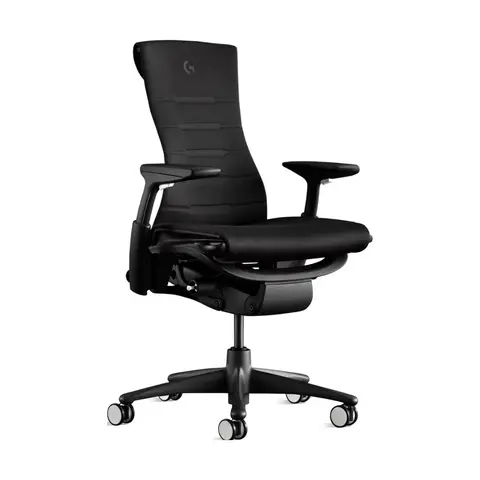
Herman Miller Embody
Designed by Bill Stumpf and Jeff Weber · Herman Miller
Long hours at a desk in a chair whose segmented back flexes as you move.
$2,230 – $2,705
About this price
varies by configuration · as of Oct 11, 2026
Source: US Herman Miller Store ↗, checked Oct 11, 2026
- Up to 300 lb
- 12-year warranty
From 170 user reviews
Summary
A pressure-spreading task chair with a pixel-matrix seat and back, shipped fully assembled.
Best for
- People who want a seat and back that adjust themselves as they shift; that is the Pixelated Support.
- Those who want to set the back's curve by hand with the Backfit adjustment.
- Buyers who want a 12-year warranty and a chair that arrives assembled.
Good to check first
- The stated weight rating is 300 lb.
- The seat is a four-layer suspension covered in fabric, so do not expect an open mesh feel.
- It is one of Herman Miller's highest-priced task chairs, so compare it with the Aeron and refurbished options.
The trade-off
The seat and back adapt on their own, but the price is high and the weight rating is 300 lb.
Value check
Lists from $2,230 at the US Herman Miller Store.
- Price
- $2,230 – $2,705
- Load capacity
- 300 lb
- Warranty
- 12 years
From 170 user reviews · 2 languages · updated Oct 4, 2026
What Herman Miller highlights
Sources
- Herman Miller Store, Embody Chair ↗Checked Oct 11, 2026
- Herman Miller, Embody Chair ↗Checked Oct 11, 2026
Pixelated Support
A grid of small pixels in the seat and back responds to small movements. Herman Miller says this spreads your weight evenly and reduces pressure.
Backfit adjustment
A control lets you change the curve of the back to match your spine. Herman Miller describes it as manual fine-tuning of the back's shape.
Four-layer seat
The seat is built from four layers with different material properties. Herman Miller says they shape to your body and let air flow.
Active and passive ergonomics
The chair combines automatic support with a few manual settings. Herman Miller says this encourages comfortable movement instead of one fixed position.
Recycled materials
The chair uses 42% recycled material and is 95% recyclable at end of life. Herman Miller builds it in a facility powered by 100% renewable electricity.
As described by Herman Miller on its official pages; not a Chairpedia assessment.
What users say
Most-mentioned topics
- 1. Price and value77 mentions · 34% positive
- 2. Comfort70 mentions · 71% positive
- 3. Build quality62 mentions · 76% positive
- 4. Back support61 mentions · 57% positive
- 5. Adjustability48 mentions · 42% positive
- 6. Seat36 mentions · 47% positive
- 7. Size and fit33 mentions · 42% positive
Inside 170 user reviews →Close
Who it suits, who it doesn't
- Suits Medium-build users in upright work: those around average height and weight using it for software development, writing, or editing sessions of eight to twelve hours report excellent spinal alignment and reduced tension
- Suits Users with scoliosis or asymmetric spines: several users with spinal curvature conditions noted the flexible backrest adapts to their body shape better than traditional lumbar supports
- Less suited to Very tall users: those around six feet three and taller report the backrest corners dig into shoulder blades and seat depth remains short even fully extended
- Less suited to Lighter or petite users: individuals under average weight find the seat uncomfortably firm, sometimes requiring added cushions, and shorter users experience pressure behind knees even at the shallowest depth
- Less suited to Heavier users: one owner at the upper weight range reported bottoming out in minutes, suggesting inadequate cushioning for larger builds
Where users disagree
Seat firmness
One side: many find it uncomfortably hard, like sitting on plywood, especially lighter users who sometimes add cushions
Other side: others appreciate the firm support after break-in, viewing it as beneficial for long-term posture and preferring it to softer alternatives
Back support effectiveness
One side: some users report the pixelated support system adapts well to their spine, including those with conditions like scoliosis
Other side: others find the fixed lumbar too aggressive or unable to adjust to their height, causing persistent pain or pressure points
Break-in period necessity
One side: many describe a crucial two-week to three-month adjustment where discomfort eventually gives way to satisfaction
Other side: some experience no improvement over months and view the learning curve as evidence the chair simply does not fit their body
Value for price
One side: long-term owners view it as a worthwhile health investment over ten-plus years, especially at sale prices
Other side: critics feel it offers minimal advantage over chairs costing a quarter as much and does not justify the premium
Users who switched
- From Herman Miller Aeron → To Herman Miller Embody: several users preferred the Embody's cushioned seat over mesh options, finding it more suitable for extended sitting sessions compared to the Aeron; one user found the Aeron less comfortable despite its popularity Comparison
- From Secretlab Titan → To Herman Miller Embody: one owner found the Embody far superior in every way, allowing much longer comfortable sitting and no regrets about the upgrade
- From cheap chairs under four hundred → To Herman Miller Embody: multiple owners emphasized the difference was immediately noticeable, with budget chairs failing within weeks while the Embody remained durable; one never wanted to return to cheaper options
- From Herman Miller Embody → To Steelcase Leap V2: several switched due to persistent lower back pain requiring physical therapy, finding the Embody pushed them into uncomfortable positions or had too-aggressive lumbar; one returned it within two weeks due to arm numbness Comparison
- From Herman Miller Embody → To Anthros Chair: one owner found the Embody back felt like cheap plastic that poked them and caused tailbone pain, while the Anthros became the most comfortable chair they ever used
- From Steelcase Gesture → To Herman Miller Embody: one user preferred the Embody's pixelated support for better pressure distribution and responsiveness, avoiding the Gesture's sinking issues Comparison
Detailed topics
- Seat too firm, feels like plywood · mentioned in roughly one in three discussions
What users did: some added gel or thin cushions; others adapted over weeks or returned the chair - Front seat edge digs into thighs · about one in eight discussions
What users did: adjusting seat depth and sitting position helped; some used footrests - No headrest included · about one in five discussions
What users did: many purchased aftermarket Atlas headrest separately, though some noted adding one voids warranty - Armrests wobble or shift slightly · a handful of reports
What users did: no fix reported; some noted this persisted from day one - Backrest corners poke shoulders · several reports from tall users
What users did: no fix reported; some hoped an Atlas headrest would help - Creaking or plastic scrunching during recline · a handful of reports
What users did: no fix reported - Seat foam compressed after extended use · a few long-term owners
What users did: no fix reported; one case involved warranty replacement
Topic notes
- Price and value: Many question whether the premium justifies the comfort gained, with some feeling it offers little advantage over chairs costing a quarter as much; those who adapted view it as a worthwhile health investment over ten or more years, especially when purchased on sale or refurbished at substantial discounts.
- Comfort: User experiences differ widely: some describe the chair as exceptionally comfortable, while others find the seat feels firm and the back support creates uncomfortable pressure; many mention an adjustment period that may last several weeks to a few months.
- Build quality: Owners consistently praise the construction and durability, with many reporting flawless performance after three to thirteen years of heavy use; isolated reports mention gas cylinder replacement, armrest wobble from day one, and occasional creaking or plastic scrunching sounds during recline.
- Back support: The fixed backfit system divides users: supporters appreciate how it naturally conforms to varied spinal shapes without rigid positioning, while critics miss traditional adjustable lumbar and report the single-mechanism approach can feel too aggressive or fail to hit the right spot for their height.
- Adjustability: The backfit, seat depth, and tilt controls are praised by those who invest time learning them, but several mention the adjustment period can be frustrating and the system is not intuitive; armrests are noted as highly adjustable yet sometimes too stiff to operate or prone to slight shifting.
- Seat: The firmness is the most polarizing aspect: many describe it as uncomfortably hard initially, especially lighter users, with some requiring gel cushions, while others appreciate the firm support after adaptation; front edge pressure on thighs and foam compression after two to three years are recurring complaints.
- Size and fit: Taller users around six feet three and above report the backrest corners poke shoulders and seat depth feels short even at maximum; shorter users find the seat still too long at the shallowest setting, causing knee pressure, and wish for a petite variant; the one-size approach does not fit all frames equally.
After long-term use
After a year or more
Long-term owners from one to thirteen years report sustained comfort and durability with minimal wear, though some notice seat foam compression after two to three years; a few develop pain after nine months to two years, sometimes due to manufacturing defects.
Only users describing six months or more of use.
Before you buy
Fit (official)
- Seat height 16–20.5 in; seat depth 15–18 in.
- Rated to 300 lb.
- Overall 43.5 in high, 29.5 in wide, 29 in deep.
Delivery and setup
- Ships fully assembled.
- Warranty 12 years.
Returns (official policy)
- Herman Miller Store: return items within 30 days.
- Check return shipping terms at checkout; other sellers set their own.
Sources: Herman Miller Store, Embody Chair ↗ (checked Oct 11, 2026)
Versions and options
Standard Embody or Embody Gaming?
Core platform
Standard Embody
Embody
Embody Gaming
Embody
Seat depth
Standard Embody
15–18 in
Embody Gaming
15–18 in
Edition-specific treatment
Standard Embody
Office textile/configuration range
Embody Gaming
Gaming-specific foam and Logitech G styling
Purchase check
Standard Embody
Textile and casters
Embody Gaming
Edition, colorway and seller terms
Specs
Sources
Size and fit
- Sizes
- One size (work chair); seat height ranges: low, standard, extended/high
- Seat height
- 16–20.5 in (40.6–52.1 cm (standard); 38.1–48.3 cm (low); 43.2–55.9 cm (extended))
- Seat depth
- 15–18 in (38.1–45.7 cm)
- Load capacity
- 300 lb (136 kg)
Adjustments
- Recline
- Tilt + Kicker (extended recline for stretching); Tilt Limiter; tilt tension knob
- Arms
- Fully Adjustable Arms (height and width)
- Lumbar support
- No separate lumbar pad: PostureFit Sacral Support and Lumbar Support standard; Backfit adjustment
Build and warranty
- Warranty
- 12-year, 3-shift
About Herman Miller
Sources
- Herman Miller, About ↗Checked Oct 11, 2026
- Founded
- 1923, when D.J. De Pree and Herman Miller bought the Michigan Star Furniture Company
- Part of
- MillerKnoll, since 2021
The company took Herman Miller's name after he and his son-in-law D.J. De Pree bought it in 1923. By mid-century it was known for modern design after De Pree hired George Nelson, Charles and Ray Eames, and Alexander Girard. In 2021 Herman Miller became part of MillerKnoll.
Compare
- Herman Miller Embody vs SIHOO Doro S300 Arms: Fully Adjustable Arms on Herman Miller Embody; 6D coordinated armrests on SIHOO Doro S300.
- Herman Miller Embody vs HBADA E3 Pro (2026 Edition) Arms: Fully Adjustable Arms on Herman Miller Embody; Armrest Height: 28.3"–34.4" on HBADA E3 Pro (2026 Edition).
- Herman Miller Embody vs Steelcase Gesture Arms: Fully Adjustable Arms on Herman Miller Embody; Width 10.25–22.5 in between arms on Steelcase Gesture.
- Herman Miller Embody vs Steelcase Leap V2 Load capacity: 300 lb on Herman Miller Embody; 400 lb on Steelcase Leap V2.
Questions
How much does the Herman Miller Embody cost?
It costs $2,230 – $2,705 at the US Herman Miller Store, depending on configuration, checked Oct 2026.
What is the Herman Miller Embody's weight capacity?
It is rated for 300 lb, according to Herman Miller's official specifications.
What sizes or versions of the Herman Miller Embody are there?
Besides the current model, you may also see Embody Gaming.
What do owners say about back pain with the Herman Miller Embody?
Back pain comes up in 20 owner review summaries. These are owners' own reports, not medical findings.
Where can I buy the Herman Miller Embody?
You can buy it from Amazon, the US Herman Miller Store or the Herman Miller Official. Check the configuration, price and return terms before ordering.
Videos


Where to buy
Amazon
Check current price
- Check price at Herman Miller ↗
US Herman Miller Store
$2,230 – $2,705
- Check price at Herman Miller ↗
Herman Miller Official
Check current price
- Shop used on eBay ↗
eBay (used)
Used from $799
Some links are affiliate links; Chairpedia may earn a commission at no extra cost to you (disclosure).
Keep exploring
Specs and prices come from the brand sources listed under Specs and next to the price; User Insights link to their originals. Confirm the exact configuration, seller and price before buying. Editorial policy
From $2,230
Where to buy